





Marangu Route Kilimanjaro: Huts, 5 vs 6 Days, Difficulty and Success Rate (2026)
Marangu Route Kilimanjaro
The Marangu Route is the oldest trail on Kilimanjaro and the only one where you sleep in huts instead of tents. It starts on the southeast side of the mountain, climbs through rainforest and moorland to Uhuru Peak at 5,895 metres, and takes five or six days. We recommend six.
People call it the “Coca-Cola Route”, and the nickname is a bit unfair. Yes, the beds are real beds and the walking is gentle at the start. But a short schedule gives your body less time to adjust, and that is where most Marangu climbers run into trouble. The fix is simple: take the extra day.
Marangu Route at a glance
- Starting point: Marangu Gate, at about 1,860 metres, on the southeast side of the mountain
- Starting point: Marangu Gate, at about 1,860 metres, on the southeast side of the mountain
- Duration: 5 or 6 days (6 recommended), plus your arrival and departure days
- Duration: 5 or 6 days (6 recommended), plus your arrival and departure days
- Distance: roughly 70 km up and down (published figures vary by operator and source)
- Distance: roughly 70 km up and down (published figures vary by operator and source)
- Accommodation: shared dormitory huts, no camping
- Difficulty: moderate to strenuous, non-technical, with less gradual acclimatisation than other routes
- Difficulty: moderate to strenuous, non-technical, with less gradual acclimatisation than other routes
Summit: Uhuru Peak, 5,895 metres
- Descent: the same trail you came up on
- Descent: the same trail you came up on
- Highlights: rainforest, Mandara Hut, Horombo Hut and the long open moorland, the Saddle between Kibo and Mawenzi, and a summit push in the small hours
- Highlights: rainforest, Mandara Hut, Horombo Hut and the long open moorland, the Saddle between Kibo and Mawenzi, and a summit push in the small hours
Marangu Route itinerary, day by day (6 days)
Distances and times vary by pace and weather, so treat these as typical.
Day 1: Marangu Gate to Mandara Hut. After registration at the gate, you walk about 8 kilometres through thick rainforest, usually around 5 hours. Mandara sits at about 2,700 metres. Expect green shade, birdsong and, if you are lucky, blue and colobus monkeys.
Day 2: Mandara Hut to Horombo Hut. You leave the forest and cross open moorland, about 12 kilometres, usually 5 to 8 hours depending on your pace. Horombo is at about 3,720 metres, with big views of Kibo and Mawenzi on a clear evening.
Day 3: Acclimatisation day at Horombo. This is the day the 5-day itinerary skips. You walk up toward Zebra Rocks, usually about 3 hours, then come back down for lunch and rest at the same hut. It feels like a rest day, but it is doing real work for your body.
Day 4: Horombo Hut to Kibo Hut. About 9 kilometres, usually around 5 hours. You cross the Saddle, a wide, barren plateau between the two peaks, to Kibo Hut at about 4,700 metres. Eat early, drink well and try to sleep before summit night.
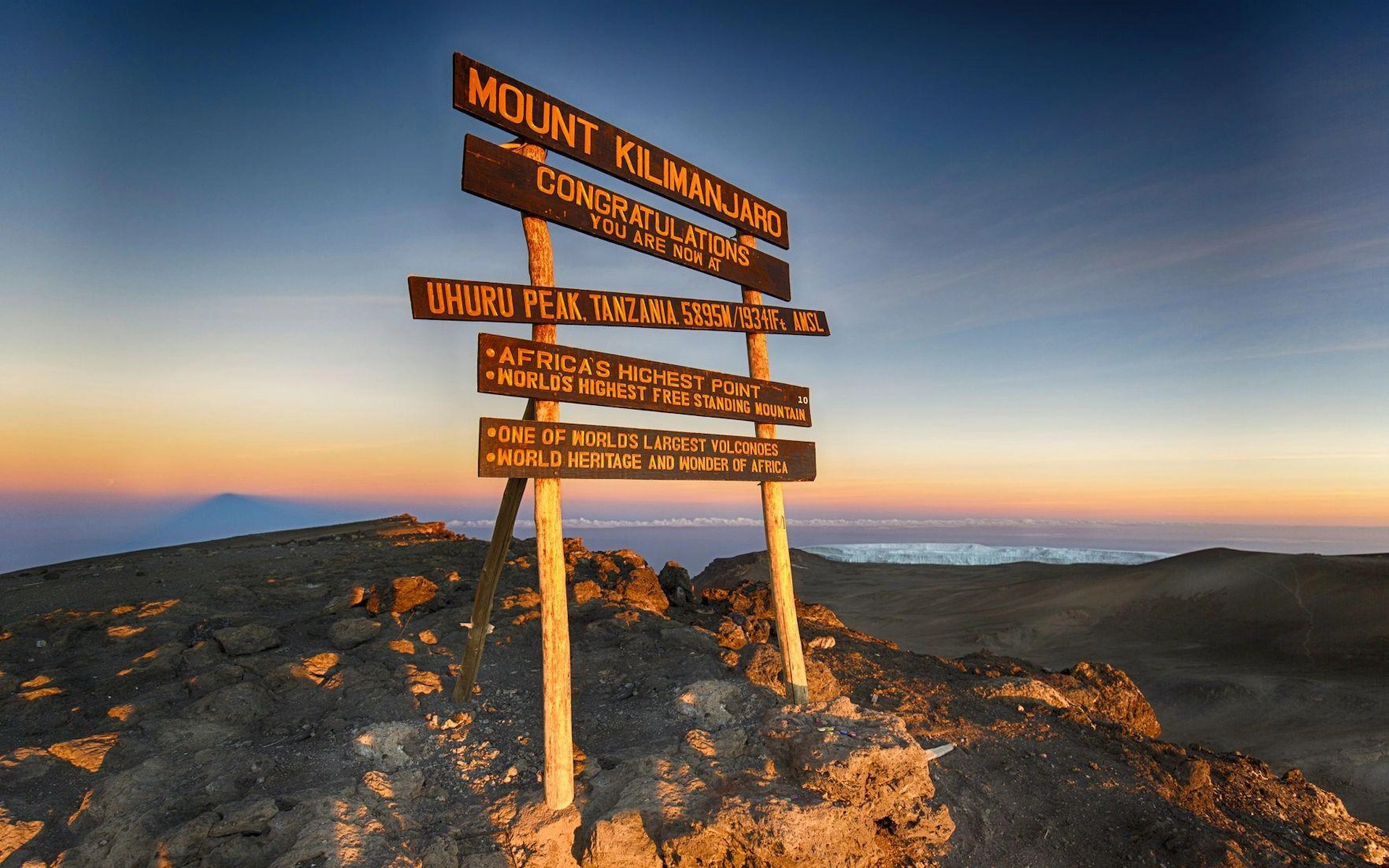
Day 5: Summit night. Your guide wakes you around 1:00 am. You climb in the dark, reaching Gilman’s Point on the crater rim (5,681 metres) after about 4 to 5 hours, then continue for another hour or so to Uhuru Peak as the sun comes up. After photos, you head back down to Kibo Hut for a hot lunch and a short rest, then walk on to Horombo Hut for your last night on the mountain. It is a long day, usually about 13 hours in total.
Day 6: Horombo Hut to Marangu Gate. A long walk down through moorland and rainforest, with a hot lunch at Mandara on the way, then the drive back to your hotel.
Marangu 5 days or 6 days?
The route is the same. The difference is one night. On the 5-day version you go straight from Horombo to Kibo and spend no extra day adjusting. On the 6-day version you spend a second night at Horombo, which gives your body time to get used to the thin air before the hard part.
Our 5-day Marangu itinerary runs Marangu Gate to Mandara, Mandara to Horombo, Horombo to Kibo, summit and back down to Horombo, then down to the gate. The 6-day version adds the extra night at Horombo before Kibo. See both: 5-Day Marangu Route and 6-Day Marangu Route.
Published success rates for Marangu vary a lot. Some operators estimate the 5-day trek at around 50 percent or even lower, while others report much higher results from their own climbs. The numbers differ because operators count different things (the crater rim or Uhuru Peak) and run their climbs differently. What every source agrees on is the pattern: the 6-day version does better than the 5-day one.
Our advice: choose 6 days. The extra day is the cheapest way to improve your chances.
Not sure which fits your dates and fitness? Message us on WhatsApp at +255 685 000 070 or email info@jairosadventure.com with your travel month and hiking experience, and we’ll recommend the right itinerary.
What the Marangu huts are really like
The huts are the reason many people choose this route, so here is what to expect. You sleep in shared dormitory-style huts, usually with bunk beds in rooms for around six to eight people, and a mattress on each bunk. It is simple and basic, but it beats a wet tent after a rainy day. Mandara and Horombo are the larger hut clusters, and Kibo is the highest and coldest.
A few honest points:
-
Huts are shared, so you may sleep in a room with other climbers.
-
Huts are shared, so you may sleep in a room with other climbers.
-
Bring your own sleeping bag. The nights are cold, especially at Kibo.
-
Bring your own sleeping bag. The nights are cold, especially at Kibo.
-
Facilities are basic. Expect simple toilets, limited washing water and no heating.
-
Facilities are basic. Expect simple toilets, limited washing water and no heating.
-
You still need warm clothes. Huts shelter you from wind and rain, but they are not warm.
-
You still need warm clothes. Huts shelter you from wind and rain, but they are not warm.
-
Book early. Huts have limited beds, and they fill up in the busy months.
-
Book early. Huts have limited beds, and they fill up in the busy months.
How hard is the Marangu Route?
Marangu is often called the easiest route, and for the first two days that is fair. The path is well worn, the gradient is gentle and you sleep in a hut. But “easiest” is not the same as “most likely to succeed”.
The route goes up and down the same trail, with fewer climb-high, sleep-low days than Machame or Lemosho. You go up steadily and sleep a little higher each night, which gives your body less room to adjust. On the 5-day version the steps between huts are bigger and the rest is shorter.
What helps most:
-
Choose the 6-day itinerary
-
Choose the 6-day itinerary
-
Walk slowly (“pole pole” in Swahili) from the first hour
-
Walk slowly (“pole pole” in Swahili) from the first hour
-
Drink enough water and eat even when you are not hungry
-
Drink enough water and eat even when you are not hungry
-
Train for 8 to 12 weeks with long hikes, hill walking and stair work
-
Train for 8 to 12 weeks with long hikes, hill walking and stair work
-
Wear boots you have already broken in
-
Wear boots you have already broken in
-
Tell your guide straight away if you feel unwell. Drinking extra water alone won’t prevent altitude sickness.
-
Tell your guide straight away if you feel unwell. Drinking extra water alone won’t prevent altitude sickness.
Marangu or Machame?
This is the most common question we hear.
- Marangu is the only hut route, and it starts gently. It also has the least gradual acclimatisation, so it fits climbers who want a bed and a roof and who will take the extra day
- Machame is a camping route with a better climb-high, sleep-low profile on Day 3, and it is more scenic and more varied. Most climbers who want the best chance of summiting choose Machame or Lemosho.
- Machame is a camping route with a better climb-high, sleep-low profile on Day 3, and it is more scenic and more varied. Most climbers who want the best chance of summiting choose Machame or Lemosho.
If sleeping in tents is the main thing putting you off, Marangu on 6 days is a good answer. If your priority is the best chance of the top, look at Machame. Read our full guides:
- Machame Route Kilimanjaro: 7-Day Itinerary & Guide and Lemosho Route Kilimanjaro: The Complete Guide to Itinerary, Difficulty and Success Rates
Still deciding between them? Message us on WhatsApp at +255 685 000 070 or email info@jairosadventure.com with your dates and hiking experience, and we’ll recommend the better fit.
Who is the Marangu Route best for?
Marangu suits:
-
Climbers who don’t want to camp
-
Climbers who don’t want to camp
- Trekkers who prefer a simple, well-marked trail with a roof at night
-
Anyone with a short window of time who is willing to take six days rather than five
-
Anyone with a short window of time who is willing to take six days rather than five
-
Families with children aged 10 and over, who want a more comfortable setup on the lower slopes
-
Families with children aged 10 and over, who want a more comfortable setup on the lower slopes
It is less suited to anyone who wants the very best acclimatisation or the most scenic variety. For that, we would point you to Machame or Lemosho.
When is the best time to climb the Marangu Route?
The two main dry windows are June to October and late December to early March. Dry months bring clearer skies and firmer trails, while the rainy seasons bring more cloud, mud and snow near the summit. Marangu is popular and can be crowded from July to September and from December to March, and because huts have a limited number of beds, book early for those months. For snow and temperatures, read Does It Snow in Tanzania? Kilimanjaro Snow, Seasons and the Best Time to See It.
What does it cost?
Park fees are set by the national park authority and are the same for every operator, and on Marangu they cover your hut stays. The difference between quotes comes from what else is included: guides, porters, food, equipment and safety. For a full breakdown, read How Much Does It Cost to Climb Kilimanjaro? A Complete Price Guide. Before you book anyone, read How to Choose a Kilimanjaro Trekking Company (And Why It Matters More Than the Route).
Climb Marangu with Jairos Adventure
A good team makes the difference on summit night. Jairos Adventure runs the Marangu Route as a 5-day or 6-day climb, in huts, with an experienced English-speaking guide, porters and a cook. Your park fees, hut stays, transport from your hotel to the gate, full-board meals on the mountain, drinking water, emergency oxygen, a pulse oximeter and a first aid kit are included. International flights, travel insurance, your sleeping bag, tips and any hotel nights before or after the climb are not.
You can join a group departure or travel privately with your own group. Children aged 10 and over are welcome. Message us on WhatsApp at +255 685 000 070 or email info@jairosadventure.com with your dates and group size, and we’ll send you a clear itinerary and quote. Hut beds on popular dates fill up early, so the sooner you ask, the more choice you’ll have.
Ready to explore more?
- Compare the two itineraries: 5-Day Marangu Route and 6-Day Marangu Route
- Prefer camping with better acclimatisation? Machame Route Kilimanjaro: 7-Day Itinerary & Guide
- Prefer a quieter start? Lemosho Route Kilimanjaro: The Complete Guide to Itinerary, Difficulty and Success Rates
-
Join others on the mountain: Kilimanjaro Group Climbs: What They Are and Whether One Is Right for You
-
Join others on the mountain: Kilimanjaro Group Climbs: What They Are and Whether One Is Right for You
-
How many days do you need? How Long Is the Kilimanjaro Climb? A Route-by-Route Duration Guide
-
How many days do you need? How Long Is the Kilimanjaro Climb? A Route-by-Route Duration Guide
- What lives on the mountain: Wildlife on Kilimanjaro: What You’ll Actually See While Climbing
-
Add a day before or after: Things to Do in Kilimanjaro, Tanzania
-
Add a day before or after: Things to Do in Kilimanjaro, Tanzania
FAQ
Search Blog
Recent Articles
Machame Route Kilimanjaro: 7-Day Itinerary & Guide
Oct 13, 2026

Ready for an Adventure?
Book your dream safari tour today and experience the wild like never before.
View Tours